An opaque type representing the source code being parsed, regardless of origin (constant memory, file, memory-mapped file, or stream). More...
#include "prism/compiler/exported.h"#include "prism/compiler/filesystem.h"#include "prism/compiler/nodiscard.h"#include "prism/compiler/nonnull.h"#include <stddef.h>#include <stdint.h>
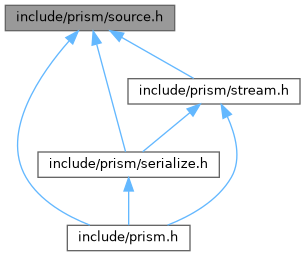
Go to the source code of this file.
Typedefs | |
| typedef struct pm_source_t | pm_source_t |
| An opaque type representing source code being parsed. | |
| typedef char *() | pm_source_stream_fgets_t(char *string, int size, void *stream) |
| This function is used to retrieve a line of input from a stream. | |
| typedef int() | pm_source_stream_feof_t(void *stream) |
| This function is used to check whether a stream is at EOF. | |
Enumerations | |
| enum | pm_source_init_result_t { PM_SOURCE_INIT_SUCCESS = 0 , PM_SOURCE_INIT_ERROR_GENERIC = 1 , PM_SOURCE_INIT_ERROR_DIRECTORY = 2 , PM_SOURCE_INIT_ERROR_NON_REGULAR = 3 } |
| Represents the result of initializing a source from a file. More... | |
Functions | |
| PRISM_NODISCARD PRISM_EXPORTED_FUNCTION pm_source_t * | pm_source_constant_new (const uint8_t *data, size_t length) |
| Create a new source that wraps existing constant memory. | |
| PRISM_NODISCARD PRISM_EXPORTED_FUNCTION pm_source_t * | pm_source_shared_new (const uint8_t *data, size_t length) |
| Create a new source that wraps existing shared memory. | |
| PRISM_NODISCARD PRISM_EXPORTED_FUNCTION pm_source_t * | pm_source_owned_new (uint8_t *data, size_t length) |
| Create a new source that owns its memory. | |
| PRISM_NODISCARD PRISM_EXPORTED_FUNCTION pm_source_t * | pm_source_file_new (const char *filepath, pm_source_init_result_t *result) PRISM_NONNULL(1 |
| Create a new source by reading a file into a heap-allocated buffer. | |
| PRISM_NODISCARD PRISM_EXPORTED_FUNCTION pm_source_t PRISM_NODISCARD PRISM_EXPORTED_FUNCTION pm_source_t * | pm_source_mapped_new (const char *filepath, int open_flags, pm_source_init_result_t *result) PRISM_NONNULL(1 |
| Create a new source by memory-mapping a file. | |
| PRISM_NODISCARD PRISM_EXPORTED_FUNCTION pm_source_t PRISM_NODISCARD PRISM_EXPORTED_FUNCTION pm_source_t PRISM_NODISCARD PRISM_EXPORTED_FUNCTION pm_source_t * | pm_source_stream_new (void *stream, pm_source_stream_fgets_t *fgets, pm_source_stream_feof_t *feof) |
| Create a new source by reading from a stream using the provided callbacks. | |
| PRISM_EXPORTED_FUNCTION void | pm_source_free (pm_source_t *source) PRISM_NONNULL(1) |
| Free the given source and any memory it owns. | |
| PRISM_EXPORTED_FUNCTION size_t | pm_source_length (const pm_source_t *source) PRISM_NONNULL(1) |
| Returns the length of the source data in bytes. | |
| PRISM_EXPORTED_FUNCTION const uint8_t * | pm_source_source (const pm_source_t *source) PRISM_NONNULL(1) |
| Returns a pointer to the source data. | |
Detailed Description
An opaque type representing the source code being parsed, regardless of origin (constant memory, file, memory-mapped file, or stream).
Typedef Documentation
◆ pm_source_stream_fgets_t
| typedef char *() pm_source_stream_fgets_t(char *string, int size, void *stream) |
This function is used to retrieve a line of input from a stream.
It closely mirrors that of fgets so that fgets can be used as the default implementation.
As with fgets, implementations MUST write at most size bytes into string, including the terminating NUL byte (i.e. at most size - 1 bytes of data followed by a '\0'). The caller relies on this bound for memory safety, so an implementation that reads from a source which may return more data than requested (for example a multi-byte-aware gets) is responsible for clamping the amount it copies. Returns string, or NULL on EOF.
◆ pm_source_stream_feof_t
| typedef int() pm_source_stream_feof_t(void *stream) |
This function is used to check whether a stream is at EOF.
It closely mirrors that of feof so that feof can be used as the default implementation.
Enumeration Type Documentation
◆ pm_source_init_result_t
Represents the result of initializing a source from a file.
Function Documentation
◆ pm_source_constant_new()
| PRISM_NODISCARD PRISM_EXPORTED_FUNCTION pm_source_t * pm_source_constant_new | ( | const uint8_t * | data, |
| size_t | length | ||
| ) |
Create a new source that wraps existing constant memory.
The memory is not owned and will not be freed.
- Parameters
-
data The pointer to the source data. length The length of the source data in bytes.
- Returns
- A new source. Aborts on allocation failure.
◆ pm_source_shared_new()
| PRISM_NODISCARD PRISM_EXPORTED_FUNCTION pm_source_t * pm_source_shared_new | ( | const uint8_t * | data, |
| size_t | length | ||
| ) |
Create a new source that wraps existing shared memory.
The memory is not owned and will not be freed. Semantically a "slice" of another source.
- Parameters
-
data The pointer to the source data. length The length of the source data in bytes.
- Returns
- A new source. Aborts on allocation failure.
◆ pm_source_owned_new()
| PRISM_NODISCARD PRISM_EXPORTED_FUNCTION pm_source_t * pm_source_owned_new | ( | uint8_t * | data, |
| size_t | length | ||
| ) |
Create a new source that owns its memory.
The memory will be freed with xfree when the source is freed.
- Parameters
-
data The pointer to the heap-allocated source data. length The length of the source data in bytes.
- Returns
- A new source. Aborts on allocation failure.
◆ pm_source_file_new()
| PRISM_NODISCARD PRISM_EXPORTED_FUNCTION pm_source_t * pm_source_file_new | ( | const char * | filepath, |
| pm_source_init_result_t * | result | ||
| ) |
Create a new source by reading a file into a heap-allocated buffer.
- Parameters
-
filepath The path to the file to read. result Out parameter for the result of the initialization.
- Returns
- A new source, or NULL on error (with result written to out param).
◆ pm_source_mapped_new()
| PRISM_NODISCARD PRISM_EXPORTED_FUNCTION pm_source_t PRISM_NODISCARD PRISM_EXPORTED_FUNCTION pm_source_t * pm_source_mapped_new | ( | const char * | filepath, |
| int | open_flags, | ||
| pm_source_init_result_t * | result | ||
| ) |
Create a new source by memory-mapping a file.
Falls back to file reading on platforms without mmap support.
If the file is a non-regular file (e.g. a pipe or character device), PM_SOURCE_INIT_ERROR_NON_REGULAR is returned, allowing the caller to handle it appropriately (e.g. by reading it through their own I/O layer).
- Parameters
-
filepath The path to the file to read. open_flags Additional flags to pass to open(2) (e.g. O_NONBLOCK). result Out parameter for the result of the initialization.
- Returns
- A new source, or NULL on error (with result written to out param).
◆ pm_source_stream_new()
| PRISM_NODISCARD PRISM_EXPORTED_FUNCTION pm_source_t PRISM_NODISCARD PRISM_EXPORTED_FUNCTION pm_source_t PRISM_NODISCARD PRISM_EXPORTED_FUNCTION pm_source_t * pm_source_stream_new | ( | void * | stream, |
| pm_source_stream_fgets_t * | fgets, | ||
| pm_source_stream_feof_t * | feof | ||
| ) |
Create a new source by reading from a stream using the provided callbacks.
- Parameters
-
stream The stream to read from. fgets The function to use to read from the stream. feof The function to use to check if the stream is at EOF.
- Returns
- A new source. Aborts on allocation failure.
◆ pm_source_free()
| PRISM_EXPORTED_FUNCTION void pm_source_free | ( | pm_source_t * | source | ) |
Free the given source and any memory it owns.
- Parameters
-
source The source to free.
◆ pm_source_length()
| PRISM_EXPORTED_FUNCTION size_t pm_source_length | ( | const pm_source_t * | source | ) |
Returns the length of the source data in bytes.
- Parameters
-
source The source to get the length of.
- Returns
- The length of the source data.
◆ pm_source_source()
| PRISM_EXPORTED_FUNCTION const uint8_t * pm_source_source | ( | const pm_source_t * | source | ) |
Returns a pointer to the source data.
- Parameters
-
source The source to get the data of.
- Returns
- A pointer to the source data.